Lido Staking Taxes: stETH Rebases, wstETH Accrual and U.S. Reporting
Lido turns an ETH staking position into transferable tokens, but the U.S. tax result is not captured by a single “staking reward” line. Taxpayers must examine the initial ETH-to-stETH transaction, daily stETH rebases, wstETH value accrual, withdrawals and later DeFi disposals. The IRS has clear reward-income guidance, but no Lido-specific ruling.
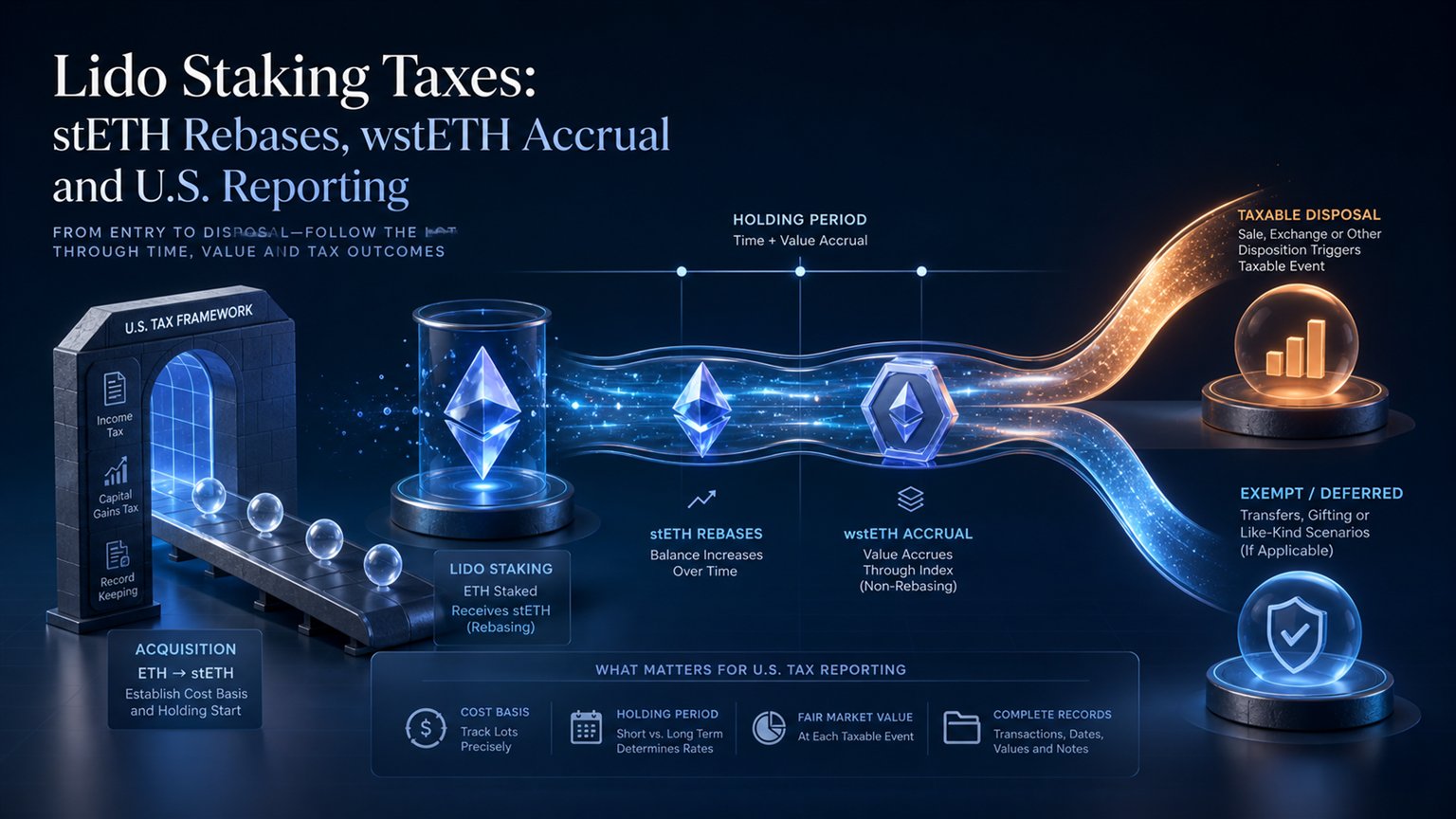
stETH and wstETH represent rewards differently
Prepare Your Crypto Tax Workpapers
Import your transactions, review the results and generate detailed tax workpapers without building the entire calculation manually in spreadsheets.
Start for free →Lido describes stETH as a transferable rebasing token representing a share of ETH staked through the protocol. Oracle reports update holder balances, generally increasing the number of stETH units as rewards accrue. wstETH is a wrapper with a static token balance: the number of wstETH units does not rebase, but each unit becomes redeemable for a changing amount of stETH.
| Asset | Token balance | Where growth appears | Tax-data need |
|---|---|---|---|
| ETH | fixed until transfer | market price | original basis and lot |
| stETH | changes through rebases | additional nominal units | daily or supportable reward accrual |
| wstETH | generally static | stETH conversion rate | share balance and rate history |
| withdrawal NFT | claim representation | claimable ETH | request, finalization and claim |
The protocol mechanics do not themselves determine federal tax treatment. A wallet may show a rebase without an ordinary transfer log, while wstETH may accrue value without more units. Tax software must understand both share accounting and the relevant tax position.
Is depositing ETH for stETH a taxable exchange?
The IRS treats digital assets as property. An exchange of one digital asset for another that differs materially in kind or extent generally produces an amount realized and a new basis. The IRS has not issued a Lido-specific ruling deciding whether the deposit of ETH and receipt of stETH is a taxable exchange or a nontaxable continuation of the same beneficial position.
A conservative reporting process therefore documents both the legal rights and the selected position. stETH is transferable, can trade at a market price different from ETH, participates in DeFi and represents a protocol claim rather than native ETH. Those facts can support exchange treatment. Other analyses focus on continued economic exposure and agency or beneficial-ownership concepts. A taxpayer should not mark the entry tax-free merely because the interface calls it “stake.”
- record ETH units and basis surrendered,
- record stETH units and fair market value received,
- save the transaction hash and protocol terms,
- document whether gain/loss and a new holding period were recognized,
- apply the same position consistently to withdrawal and wrapping.
Staking rewards are income when dominion and control exists
Revenue Ruling 2023-14 states that a cash-method taxpayer includes staking rewards in gross income when the taxpayer has dominion and control over the awarded units. The amount included is fair market value at that time. The IRS’s 2026 digital-assets page also identifies a Tax Court memorandum decision confirming staking rewards as income.
Revenue Ruling 2023-14 addresses native validation rewards and does not itself settle Lido receipt-token or wrapper income timing. For rebasing stETH, the report needs a supportable method to measure additional units over time and determine when they became controlled. Lido’s daily oracle accounting can create small balance increases without ordinary transfers. Aggregation may be operationally necessary, but the report must preserve starting balance, ending balance, transfers, negative adjustments, dates and USD valuation methodology.
Income recognized for reward units becomes tax basis in those units. A later sale or exchange creates a separate capital gain or loss equal to proceeds less adjusted basis. Reporting the later proceeds without reward basis overstates gain.
Rebase example: adjust for transfers before measuring rewards
A stETH account starts with ten units, receives one previously owned stETH from another wallet, sends two stETH to your other wallet, and closes with 9.05. Ignoring fees and negative adjustments, the unexplained increase is 0.05 stETH: 9.05 − 10 − 1 + 2. It is not a 0.95-stETH reward loss, and the one-stETH transfer is not earned income.
Assume your supported tax position recognizes that 0.05 as controlled reward property at $3,000 per stETH. Record $150 ordinary income and $150 basis for those units. If those specifically identified units are later sold for $160, the separate capital gain is $10. Previously owned transferred lots keep the basis established under your entry and wrapping positions.
Use share and rate history to corroborate the calculation; rounding and rebases can occur without ordinary transfer logs. For wstETH, a static unit balance requires a different measurement and legal analysis. This example does not establish daily income treatment for every accruing wrapper.
wstETH does not eliminate the reward question
Lido documents wstETH as a value-accruing ERC-20 wrapper. Its unit balance remains static while its value in stETH changes. Wrapping stETH mints wstETH; unwrapping burns wstETH and returns stETH based on the current conversion rate. The absence of a daily token balance increase does not, by itself, prove the absence of taxable income.
Two separate questions arise. First, is wrapping or unwrapping an exchange of materially different property? Second, how and when is staking return reflected for a taxpayer holding an accruing wrapper? There is no IRS ruling that resolves these Lido-specific questions. The selected treatment should be documented, not hidden behind a zero-income import.
- track stETH shares before wrapping,
- record wstETH minted and conversion rate,
- retain daily or event-based stETH-per-wstETH rates,
- record unwrapped stETH and date,
- reconcile total economic return with income and gain calculations.
For broader reward principles, see the U.S. crypto staking tax guide.
Lido withdrawal, claim and market sale
A protocol withdrawal can involve multiple steps: a request, receipt of an unstETH withdrawal NFT, finalization and claim of ETH. A market sale of stETH or wstETH is simpler operationally but is still a disposition. Each path requires proceeds, basis, holding period and transaction costs.
| Action | Potential tax event | Records |
|---|---|---|
| sell stETH for ETH | property exchange | FMV, basis, fee |
| wrap stETH | classification required | shares and rate |
| request withdrawal | possible exchange for claim/NFT | request ID and values |
| claim ETH | settlement of claim | finalization and amount |
Capital-asset transactions are generally reported on Form 8949 and Schedule D. Ordinary staking income belongs in the applicable income category based on the taxpayer’s facts. A business validator or dealer may have different character and self-employment consequences.
Using stETH or wstETH in DeFi adds another layer
Supplying stETH to a lending market, contributing it to a liquidity pool, bridging wstETH or receiving a vault share can create additional tokens and claims. Broker reporting rules intentionally reserved several DeFi classifications for future guidance; a generic “deposit” label is not a federal tax conclusion.
- identify every token and contract address,
- separate principal from reward and borrowing flows,
- track LP, receipt and vault-share tokens,
- record bridge burn/mint and destination chain,
- do not double count rebase plus protocol reward,
- mark unknown pricing as unresolved rather than zero.
The DeFi tax guide provides a transaction-level framework, while the Ethereum tax guide covers ETH disposals and gas.
Records, basis and federal forms
For transactions on or after January 1, 2025, current IRS FAQs apply wallet- or account-specific basis principles. A taxpayer must preserve acquisition date, units, basis, fair market value, disposition date, proceeds and fees. A duplicate backup of private keys does not merge separate wallets for federal basis identification.
- export wallet and protocol event history,
- reconstruct stETH balance changes and wstETH rates,
- value rewards in U.S. dollars at the selected control time,
- link income basis to later dispositions,
- separate transfers from exchanges and gas disposals,
- reconcile Form 8949 proceeds with any broker form,
- retain the written Lido-specific tax assumptions.
A tax platform comparison should prioritize this audit trail over a simple APR import; see our crypto tax software comparison.
Frequently asked questions about Lido taxes
Are stETH rewards taxable in the United States?
Staking rewards are income when the taxpayer has dominion and control. Applying that rule to rebasing stETH requires a supportable balance and valuation method.
Is ETH to stETH definitely tax-free?
No Lido-specific IRS ruling says so. The exchange-versus-continuation analysis should be documented from the actual rights received.
Does wstETH avoid staking income?
A static token balance does not by itself decide income recognition. The wrapper’s value accrual and taxpayer’s rights must be analyzed.
What is the basis of reward units?
The amount included in income generally becomes basis in the reward property, subject to the taxpayer’s facts and accounting.
Is selling stETH for ETH taxable?
It is generally a property disposition if the assets differ materially, producing gain or loss based on proceeds and adjusted basis.
Can I rely only on a 1099-DA?
No. Broker data may not contain complete basis, self-custody history, rebases or DeFi transactions. Reconcile it to wallet records.
Primary sources
- IRS Revenue Ruling 2023-14: staking rewards
- IRS: Digital assets guidance and current developments
- IRS: Digital asset transaction FAQs
- Lido Docs: stETH and wstETH accounting
Reviewed October 9, 2026. This educational article highlights unresolved Lido-specific classifications and is not individualized tax advice.
Related Resources
Generate Your Crypto Tax Report
Import your transactions, review the results and generate a detailed PDF report with a transaction-level audit trail.
Start for free →Disclaimer: This article is for general informational purposes only and does not constitute tax advice. For individual tax advice, consult a licensed tax professional.